Research group Rehabilitation Research
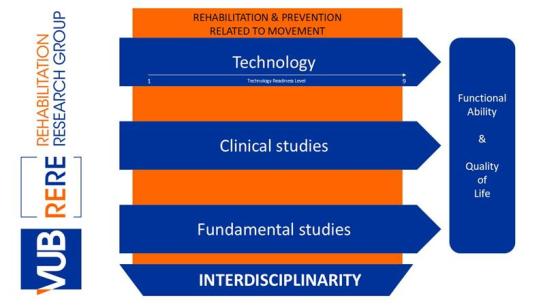
The Rehabilitation Research group (RERE) is driven by a single, overarching ambition: to enhance quality of life through movement and technology. All members of RERE share a common purpose—to provide the strongest possible scientific evidence for rehabilitation strategies that improve quality of life by optimizing physical functional ability. This ultimate goal is represented by the blue square on the right of the visual (Figure 1). We are firmly convinced that lifelong physical autonomy is achievable, and that rehabilitation science plays a key role in making this a reality.
At the core of RERE’s work lies a strong focus on movement, shown as the orange square in the visual. We address movement not only in the context of rehabilitation after injury or disease, but also from a preventive, lifespan-oriented perspective, aiming to preserve and restore functional ability across diverse populations.
RERE has consistently prioritized interdisciplinary research, symbolized by the blue pot at the bottom of the visual. While rooted in rehabilitation sciences, we actively integrate insights from engineering, health sciences, behavioral sciences, and clinical practice. This interdisciplinary approach allows us to tackle complex rehabilitation challenges from multiple perspectives and to translate innovation into meaningful, real-world impact.
To operationalize this mission, RERE structures its work around three interconnected focus domains, represented by the horizontal blue arrows.
The first domain is innovative rehabilitation technology research, spanning the full spectrum of Technology Readiness Levels (TRL 1 to 9). RERE is positioned as a crucial liaison between technical development teams and end-users, ensuring user-centeredness throughout the entire development process. By embedding novel technologies within rigorous clinical research frameworks, RERE helps translate technological innovation into evidence-based rehabilitation interventions.
The second domain focuses on clinical studies, where RERE evaluates the effectiveness of rehabilitation interventions in real-world contexts. These studies are explicitly aligned with implementation science, ensuring that effective interventions are not only scientifically sound but also feasible, scalable, and adoptable in clinical practice.
The third domain consists of fundamental studies, which generate the underlying knowledge needed to understand mechanisms of action and to prepare the ground for future clinical innovation. These studies provide essential insights that inform both technology development and clinical effectiveness research.
Together, these domains form a coherent research ecosystem in which fundamental knowledge, clinical evidence, and technological innovation continuously inform and reinforce one another—all in service of RERE’s central ambition: optimizing functional ability through movement and technology to improve quality of life across the lifespan.